Abstract
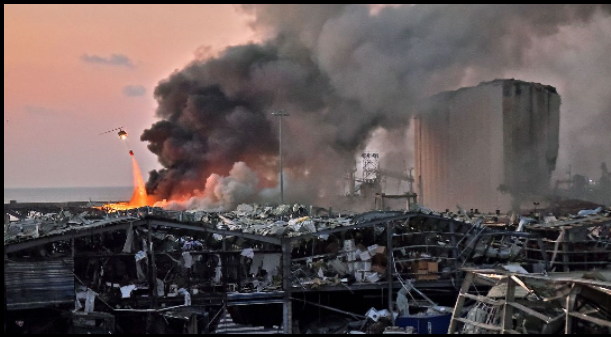
The justice gap for massive criminal cases such as Beirut Blast case known as Beirutshima is well-documented, that hot summer day when a massive explosion rocked the Lebanese capital of Beirut on Tuesday the 4th of August 2020 at 18:08 local time, killing at least 218 people, injuring more the 7,000 and leaving some 300,000 displaced.
The blast has been linked to a large supply of confiscated and potentially unsecured explosive material, stored in a warehouse at the city’s port, close to populated areas, which detonated, damaged and pulverized surrounding areas and being felt as far as 240 kilometers away.
Shortly after the blast, world leaders and international organizations stepped in to offer assistance. As in any similar criminal case, prompt examination of the crime scene and its surroundings is of paramount importance for the outcome of the local official’s investigation. Such was the case following the Beirut Blast, where world leaders and international organizations quickly stepped in to offer assistance, gather evidence, while describing the situation and crime scene as chaos.
After more than 1000 days of this local legal hand concluded as mismanagement and corruption, negligence dereliction and malfeasance on duty, it comes to an end that the Lebanese organs, combined, bear the primary responsibility for the lack of security, investigation, protection, law and order in Lebanon. The Lebanese service has demonstrate serious and systematic negligence in carrying out the duties usually performed by a professional national apparatus. In doing so, they severely failed to provide with an acceptable level of conduct and, therefore, have contributed to the propagation of a culture of intimidation and impunity.
The internationalization of the local justice:
Global criminality among the more significant aspect of the wide dimension of a crime, Globalization “supplanting an earlier French term Mondialization” helped the process of interaction and integration among countries and people. Globalization is producing new challenges for criminal justice practitioners and researchers.
Two main components define the settlement of the international tribunal laws, the Non-Immunity and the Non-Limitation of the crime.
No Functional Immunity for Crimes under International Law.
Considering the circumstances surrounding the port explosion, the international community support the idea of considering this Blast under the Crimes Against Humanity listed in Rome Statute and allowing to eliminate claims of high-ranking state official immunities. Functional immunity (also referred to as immunity ratione materiae) must be distinguished from personal immunity (immunity ratione personae). While the former is granted to any state official, regardless of their rank within the state apparatus, for any official act committed during their term of office, the latter is conferred on a strictly limited group of high-ranking state officials in particular heads of state, heads of government and ministers during their term of office. Personal immunity therefore protects ‘state officials whose freedom of action in international intercourse is especially important to the functioning of the state’. For this reason, it applies without exception before foreign domestic courts even if the protected person is accused of crimes under international law. In contrast, it was long-standing consensus that foreign state officials are not protected from foreign domestic prosecution by functional immunity in cases where crimes under international law are concerned, even though the doctrinal reason for this exclusion is controversial.
“This Statute shall apply equally to all persons without any distinction based on official capacity, In particular, official capacity as a Head of State or Government, a member of a government or parliament, an elected representative or a government official shall in no case exempt a person from criminal responsibility under this Statute, nor shall it, in and of itself, constitute a ground for reduction of sentence” – Rome Statute Article 27.
The tragic events of the 20th century have shown that the immunity enjoyed by world leaders led them to commit the most heinous crimes exactly because they knew they could act with impunity. The Rome Statute is the most important development in history to rein in this unchecked abuse of power.
Non- application of Statute of Limitations.
The importance of international prosecution of the perpetrators of such serious crimes diminishes only slightly over the years, if at all. On this point, it is important to recall Article 1 of the UN Convention on the non-applicability of statutory limitations to war crimes and crimes against humanity, New York, 26 November 1968, which stipulates that such crimes are not subject to statutory limitation, or crimes of a seriousness justifying their exclusion from statutory limitation, the Trial Chamber considers that a lapse of time of almost twelve years between the commission of the crimes and sentencing proceedings is not so long as to be considered a factor for mitigation.
Furthermore, the article 29 of Rome Statute provides for the non-applicability of statutory limitations to the international crimes that are subject matter of the International Criminal Court.
Conclusion
Building on the findings of the Lebanese investigations to date and on the basis of the material and documentary evidence collected and the leads pursued until now, there is converging evidence pointing at Lebanese responsible involvement in this explosion act. It is a well-known fact that Lebanese authority had a pervasive presence in the port. The former Lebanese prime minister annulled his visit to the port a few days before the explosion.
Lebanese investigation services working in tandem, determined it would be difficult to envision a scenario whereby such a complex explosion plot could have been carried out without their knowledge.
This examination of the trend toward criminal justice as an international enterprise considers the international character of crime.
Therefore, the continuing investigation should be carried forward by the appropriate international judicial and security authorities, so they can move ahead and at times take the lead in an effective and professional manner. At the same time, the Lebanese authorities should look into all the ramifications of the case. Consequently, it is essential that a sustained effort be made on part of the international community to establish an assistance and cooperation platform in conjunction with the Lebanese authorities in the field of security and justice. This will considerably boost the trust of the Lebanese people in their security and legal systems, while building self-confidence in their capabilities.
As a result of the international investigation, a number of people should be arrested and charged with conspiracy to commit “Crimes Against Humanity”. However, we are of course of the view that all people, including those charged with serious crimes, should be considered innocent until proven guilty following a fair trial.
It became clear that the Lebanese investigation process suffers from serious flaws and has neither the capacity nor the commitment to reach a satisfactory and credible conclusion. To find the truth, it would be necessary to entrust the investigation and the legal process to an international independent commission, comprising the different fields of expertise that are usually involved in carrying out similarly large investigations in national systems. Furthermore, it is more than doubtful that such an international commission could carry out its tasks satisfactorily and receives the necessary active cooperation from local authorities while the current leadership of the Lebanese security services remains in office.
Finally, Regional and International legal support will be necessary to safeguard Lebanon’s national unity and to shield its fragile polity from unwarranted pressure. Improving the prospects of peace and security in the region would offer a more solid ground for restoring normalcy in Lebanon.
Obviously, since no one is going to sign the agreement of his own demise, the international community should take swift action and handle the case in their halls using the authority of Chapter Seven of the United Nations Charter in order to make evident the truth.
“Improving justice begins with establishing that Famous People are not above the law”.
By Elias Nabil Hassoun
PhD in international criminal law